Showing posts with label interview. Show all posts

Thursday, September 22, 2022

Mark Waid on writing "Valor" and the Legion's "End of an Era"

Prior to covering this week's episode of the podcast, which looked at the finale of the 5YL Legion in LSH v4 #61, I asked Mark Waid if he could answer some questions and share some stories about writing the Legion during this period in 1993-94. He was gracious enough to answer, and even told me some things I had never heard before. Thanks, Mark!


Omnicom: The first of the Legion books you started on was Valor with #11, which according to the solicitations was the “Beginning an exciting new direction for VALOR that will ultimately lead to a major shake-up in the DC Universe.” That issue came out when the Bierbaums were still writing both LSH (then on #47) and Legionnaires (then on #7), and was on sale a year before Zero Hour. Your first issue as regular writer wrapped up the plots from the previous team. How much did you know at the time about what DC was planning for the future of the DCU in the form of Zero Hour? How much direction were you given on the title?


Waid: At first, in the Valor days, the outcomes of Zero Hour were held close to the vest, though it helped enormously that Legion editor KC Carlson was also the editor of ZH--so he could at least set up guard rails for me, and I'm sure the solicits were from his keyboard, not mine, so he could say with some authority what I didn't at the time know.

Once we got to End of an Era, we knew the outcome of ZH, so we knew where we were going.

Omnicom: The Bierbaums were off of the LSH book with issue 50 and Tom McCraw took over as writer. Do you recall at what point you started working together to plot out the future of the Legion books?

Waid: I want to say about four months before the first chapter of End of an Era came out? It's hard to remember after all this time, but that would make sense.

Omnicom: The Bierbaums stayed on the Legionnaires book up through #15, and by that time Valor had finished up DOA – the 20th century version of the character was dead, and the SW6 version was now starring – while Tom’s LSH book was wrapping up the Legion on the Run story. It’s clear (in retrospect) that things were moving towards something big, and Kurt Busiek joined the writing team. Can you talk about the writing process bringing together three books which up until that time had not been involved with each other?

Waid: Well, Tom, KC and I were friends as well as workmates, so the process was easy--and bringing Kurt in was to help me out because I couldn't juggle all my pieces of End of an Era and hit my other deadlines. I didn't have a whole lot of personal communication with Kurt in the process (though we, too, were friends)--mostly, he was just springing off the outline that Tom and I had crafted--but it was nonetheless a seamless process as I recall.


Omnicom: Somewhere in there is the infamous “it’s broken and we can’t fix it!” plotting session. Can you go through what you, Tom, Kurt, and KC Carlson & Mike McAvennie (and whoever else) went through in figuring out how to try to fix and then end the series? Were you given any story beats to hit or avoid other than to make sure that things matched up with the Zero Hour title? Was that decision yours (collectively) or was there a mandate from above to end with a Legion reboot?

Waid: Oh, there was far more than one "how do we fix this?" plotting session. KC, Tom and I spent countless hours across several weekends in Tom's studio throwing ideas around. And as I have said repeatedly, even though hardcore Legion fans don't want to believe me, the amount of energy we spent trying to figure out some way to salvage existing LSH continuity could move the Pyramid at Giza. Remember, all of us were die-hard Legion fans. Tom and I were both long-time members of Interlac, the Legion fan group. I knew more about the Legion at that point than probably anyone else in the world save maybe Paul Levitz--I was the one who created the famous Legion Index covering all of Legion history in excruciating detail. We loved the Legion. We didn't want to bury history. But at the same time, no matter how many plotting paths we went down in order to salvage it, they all became just too Byzantine, and I distinctly recall pointing out late in the game that it felt like we were trying to build a house on shifting sand. The Superman office had already dictated that there were to be none, zero, no ties between the LSH and the Superman mythos, and other DC editorial offices were following suit, stripping us of mention of the Green Lantern Corps and the Thanagarians, both of which had played a role in LSH history. And we had no idea what we'd be stripped of next. Every attempt to simply replace verboten characters with other characters took us to places that would be more confusing than edifying to non-hardcore LSH readers. No one was campaigning for a reboot. It wasn't a goal; it was a necessary evil that we all then tried to make the best of.

Omnicom: I became a member of online fandom on Compuserve during Zero Hour, right before LSH #61 (the finale) came out, and I recall a discussion of that two-page spread at the end where we see vignettes of various points in Legion history. Can you talk about that? If I remember correctly, you had asked fandom what to put there (without telling them what you were going to do).

Waid: I did reach out to my fellow Legion fans, but the obvious choices were obvious--Ferro Lad, the cover of Adventure 312, and so forth. The only image I can take personal credit for is the image of Luornu crawling through Superboy's secret tunnel in Smallville; it resonated (and still resonates) with me in a hugely emotional way, being the perfect condensation in one image of writer Jim Shooter's skill at characterization, the moment that we really got hit hard with the intensity of her crush on Superboy and the tragedy of knowing they'd never be together. I knew that image would resonate with the hardcore fans--a few years earlier, in 1992, I'd been at a Legion fan gathering where someone had put together a slide show commemorating the Legionnaires who'd died in battle, and when that image of Luornu came up, the entire room gasped a melancholy gasp. It was a beautiful and moving moment.


I was surprised to hear Mark say that "other DC editorial offices were following suit, stripping us of mention of the Green Lantern Corps and the Thanagarians", that's something I had never heard before. The Superman office, yes, but not Green Lantern or even the Thanagarians.

Wednesday, August 10, 2022

Kurt Busiek on "Valor" and "End of an Era"

We just wrapped up the Valor series with issue 23, which was part 5 (of 6) of End of an Era. I asked Kurt about his time on writing Valor.

I was invited to write the last four issues of VALOR when Mark Waid moved over to writing whichever Legion book he took over, and I’m a big Legion fan, so of course I said yes. And I’m a fan of Colleen Doran’s work, too, so that made it a very easy book to say yes to.

The first two parts, pre-End of an Era, needed to wrap up Valor’s present-day mission (I think; it’s been a long time). My main memory of those two issues was that ever since I was in high school, I thought it would be cool to have some present-day DC hero have to deal with an army of Braalians — essentially a mass invasion of Magnetos. So when I needed someone to build this story around, I suggested we see Braalians, but somewhat more primitive Braalians than were in the 30th century. More of a warrior culture, like Space Conan or something. Colleen fastened on that to decide they’d be bare chested with great hair, and for the duration of that story we called them the Super-Fabios of Space. And they looked great.

As far as End of An Era goes, the story had been conceived before I got there, but I got to be part of the plotting sessions with Mark and Tom (and KC and/or Mike McAvennie was on the calls, too, I think, but mainly I remember Mark and Tom).

My big contributions were (a) how to defeat Mordru, by bringing in the Infinite Man (one of my favorite Legion foes from when I was reading the book) and having Mordru take his power, so Mordru’s claustrophobia was triggered by the Infinite Man’s infinite consciousness — if his consciousness is infinite, then there’s nothing beyond it, so it’s psychologically the same as being buried, (b) the explanation for where the SW6ers had come from, and (c) the idea that the adult Legion and the kid Legionnaires should shake hands and merge at the end, to answer the question “Which ones were ‘real’?” by saying, “They both were.”

I also really wanted to make it clear that as the time/crisis/whatever-wave washed over them, that they had a sense of continuation, that it wasn’t that these characters were being destroyed and other characters would replace them, but that these characters’ spirits would live on, embodied in revised versions of the continuity — so the post-Zero Hour Legion could be seen as the originals in a new form, rather than replacements for the originals.

I don’t think a lot of readers saw it that way, but hey, I wanted to try for that, at least.

It’s the one chance I’ve really had (so far, at least) to write the Legion, and I had a good time doing it, particularly writing Valor and Shady, writing a version of Superboy, and getting to write a lot of other favorites along the way.

It didn’t get the Legion out of my system or anything — I'd still like to write them someday — but it was a thrill to do those couple of issues, and to be involved in a big story, even if it was a farewell.

Hope that helps!


Friday, April 29, 2022

RIP Neal Adams

Neal Adams needs no introduction, and many people will write elsewhere lots of good things about him and what he did for the industry over the years. So instead, I'm just going to recap his Legion work.


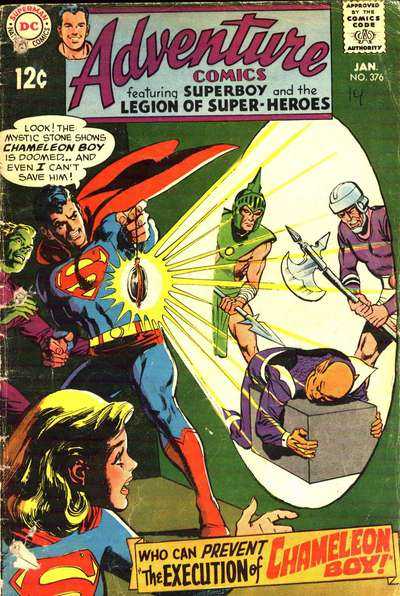
In the late 1960s, Adams drew a lot of covers for DC, including Adventure Comics, for which he pencilled and/or inked 13 covers towards the end of the Legion's run.

His first cover was #365, introducing Shadow Lass. It’s not that the previous covers by Curt Swan were not good, it’s just that Adams’ covers were that much better. He then did #366 (Validus blasting Superboy in a boxing ring, a precursor to his later Superman vs Muhammad Ali tabloid), #367 (surrounded by shadowy members of the Dark Circle), #368 (the mutiny of the super-heroines), #369 (intro Mordru), #371 (Superboy leaves the Legion), #372 (Superboy is smashed as a glass statue), #373 (the Tornado Twins), #375 (Bouncing Boy is the most powerful Legionnaire), #376 (the execution of Chameleon Boy; inks over Swan pencils), #377 (the Legionnaires are for hire; inks over Swan pencils), #378 (the Legionnaires are dying; inks over Swan pencils), and #379 (the dead Superboy is ejected into space; inks over Infantino pencils).

Jim Shooter recalled working with Adams in this 2008 interview:

JS:  By the way, it was great working with Neal, although I only worked with him on covers.  In the old days with Mort, with every story Mort required a cover sketch or a detailed cover idea if the writer in question could not sketch.  As a matter of fact, he required two cover sketches for each story.  What he would do is he would take the better one and make it the cover and make the other one the splash page because he used to do the symbolic splashes, rather than splash panels that started the story.  He’d call it the second cover.  So, I did two cover sketches. 

When I did the interior stuff I just did it in pencil, but with the cover sketch, I colored it, because they taught me how to color, so I did a whole color comp of this cover.  I put the logo and everything.  And usually they’d pick one of my designs and follow it.  I can’t think of an instance where they didn’t pick one of them.  What was really, really cool was the first time the book comes out and I see the cover and it was Neal Adams.  It was like, “Whoa!”  It was amazing.  Because more than any other guy, Neal would look at my crude little drawing and he would know what I meant.  And he would say, “All right.  I’ve got it.”  And then he would do this brilliant thing that was like he was reading my mind.  (Chuckle.)  And I would look at it and say, “Yeah, I meant that.”  (Mutual laughter.)  “That’s what I meant.  Yeah, good work, man.”

Stroud:  Just knocked it out of the park.

JS:  Oh, unbelievable.  Doing those covers with him…I just couldn’t wait to see what he did.

Stroud:  Sure.  You and the rest of the world.  He’s a formidable talent. 

Adams also did a wraparound cover for Batman #238, which inexplicably contained a Legion reprint story (from Adventure 324, the Legion of Super-Outlaws aka the Heroes of Lallor) and featured on the cover all of the characters inside the book.


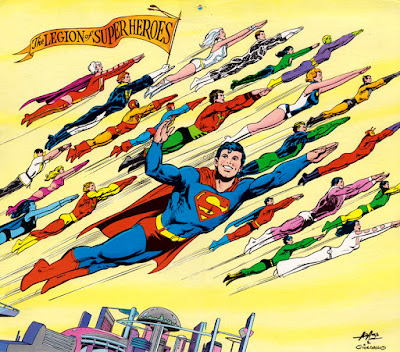
Adams pencilled a famous group shot of the Legion for the 1976 DC Calendar, inked by the late great Dick Giordano, and this was later reused (with some cropping and rearranging of characters) as the cover to the 1978 Tempo paperback book with Legion reprints.


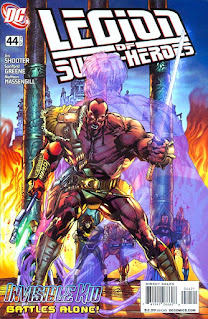
Finally, a few decades later, Adams provided what would turn out to be his final Legion cover, a variant for issue #44 of Jim Shooter's Threeboot run (LSH v5) cover-dated Sept. 2008. In the above interview, Shooter continued:

JS:  He’s doing a cover for the new series, by the way. 

Stroud:  Oh, is he?  I hadn’t heard that.

JS:  Yeah for issue #44.  Yeah, he asked to do it.  He actually sent an e-mail to Levitz and Didio saying, “Hey, good move hiring Shooter and I want to do a cover.”  And they asked me, “Would that be okay with you?”  I said, “Oh, sure, let’s give the kid a break.” 

Stroud: (Laughter.)  Yeah, I guess we could do that.

JS: “We could see our way clear.”  So anyway, he insisted I give him a sketch, and so I did, and now I’m sitting here and can’t wait to see it.  I can’t wait to see it.  It’s going to be cool.  I’m not going to get many covers from him, he’s a busy guy, but it’s a very, very cool that he wanted to do one. 

Stroud:  Absolutely.  I can feel the chills down your spine from here. 

JS:  It’s going to be good.

Monday, February 21, 2022

Whatever Happened to: Mischa McDowell (aka Michelle Bryant)?

While doing these annotations, I noticed a name I wasn't familiar with in the credits on Valor #14: Mischa McDowell, on inks over Colleen Doran. I looked her up in the Grand Comics Database, and I saw that her only credits (at least under that name) were Valor #14-19, and one Star Wars cover. Essentially her entire career was inking Valor! I liked the way her inks looked over Doran's pencils, so I attempted to track her down to see... whatever happened to her?

Here are some selected sample pages from her run on Valor:

issue 14 page 1 (first page from first issue) on left, page 5 on right

issue 16 pages 14-15

issue 17 pages 2-3

issue 19 page 4 on left, page 23 on right (final page from final issue)

I started with Colleen Doran herself, I asked if she remembered working with McDowell. 

In a non-stalker method, I tracked down McDowell (now Michelle Bryant), and when I told her about the podcast and my desire to find out more, she was delighted to provide me with the following (links and cover dates in brackets are from me):

I wanted to be a comic book artist since I was very young. I was a kid in the 1980s, and it was unusual then for a girl to be into comics. My mom would buy them for me at garage sales, and that’s probably where my interest started. I used to bike to the local convenience store for new issues and would occasionally beg a ride from my dad to the comic book store downtown. I spent hundreds of hours reading them.

My high school in Madison, Wisconsin had a senior-year program where you could apprentice with an outside artist. I knew that Steve Rude of Nexus fame lived in town, so the program coordinator contacted him on my behalf, asking if he would be my mentor. Steve is a really nice guy and an incredible artist. I learned a lot from him, and we’ve been friends now for 34 years.

I then started college in Bloomington, Illinois where I met Steve Bryant (author and artist of Athena Voltaire) when he was working at a comic book store. He introduced me to a local group of artists (including Tim Bradstreet, now widely known for his comic book covers) who did illustrations for local gaming magazines. We sold our art at numerous conventions including the early years of Gen Con.

A couple years later, I very nearly got my first break. Jill Thompson, a friend of Steve Rude’s, had given me photocopies of her pencils from Sandman. She liked the resulting inking samples I sent her, and she was about to start work on DC’s series Black Orchid [issue 1 cover dated 9/93]. The book’s editor liked my work, but he was hesitant to put an unpublished artist at the beginning of the run. We left it with the understanding that I would start a few issues in, but it never did happen.

Steve Rude also introduced me to Colleen Doran. I already loved Colleen’s series A Distant Soil and was familiar with her work. This connection led to my being brought in as inker for DC Comics on Valor issue #14-19 [cover dates 12/93 to 5/94]. I worked on the series through the summer [1993] and moved from Wisconsin to Arizona in between issues. Once I got to Arizona, the editor told me that FedEx had lost the pages for the next issue. This excuse kept up for the next couple weeks until I called Colleen who was very surprised and told me that the pages were with another inker; it turned out that I had fired. I was never told. I understood their decision as I had missed a couple of deadlines, but if I had known in advance, I wouldn’t have incurred the expense of moving.

Over the next few months, I sent many inking samples to various comic book publishers in search of work, but I didn’t find any. This was also right around the time the comic book market went into a steep decline. I eventually ran out of money and moved back to Wisconsin. After that, I did receive a call from an editor at Dark Horse Comics who had seen my samples in their archive. He liked my graphic style and offered me the covers on Classic Star Wars: The Early Adventures #7 and #8. I did do #7 [cover date 2/95], but the penciller chose to ink his own work on #8. 

That was the last comic book art I did. After that, I worked as a picture framer and a book binder, as well as a stained glass artist and lampworker, making and selling over a million, little glass beads. A couple years ago, due to health reasons, I quit hot glass and moved into online reselling, especially vintage and antiques. Writing this reminds me: I still need to sell most of my original comic book art from Valor. 

I love what I do now as it’s endlessly interesting, and it involves a lot of photography which is what I went to college for in the first place. Would I go back into comic books if given the chance? I would need a lot of practice to get back to where I was, but yeah, probably. That dream never dies. :-)

You can find her online stores for "What's Gone Around" on eBay, Etsy, and Mercari.


Saturday, September 12, 2020

LSH animated series: Live, from the DC Fandome, it's Saturday Afternoon!

 On Saturday Sept 12, the DC Fandome event (part 2) finally showed (recorded, streaming on demand) a 30-minute discussion with the producer, director, and voice actors from the 2006-08 Legion animated show. (It was originally to have been at the one back in August, before that was split into two, mostly movies in part 1 and mostly TV in part 2.)

  • Top row: moderator Damian Holbrook (TV Guide), director Brandon Vietti, producer James Tucker
  • Middle row: Andy Milder (voice of Lightning Lad), Shawn Harrison (voice of Timber Wolf, Ronn Karr), Adam Wylie (voice of Brainiac 5, Computo, Colossal Boy)
  • Bottom row: Kari Wahlgren (voice of Saturn Girl, Triplicate Girl, Shrinking Violet, White Witch, Ayla Ranzz), Yuri Lowenthal (voice of Superman)

After the introductions, here's the transcript. 

Friday, July 24, 2020

Live (streaming) from San Diego, it's Friday afternoon! Comic-Con@Home - DC@Home Day 1

With the San Diego Comic-Con cancelled for 2020, they have put together a virtual convention. Replacing the usual DC panel, for Friday July 24 they live-streamed a panel in which all of the guests appeared via Zoom (or something similar).

Per the Comic-Con website, here's the panel description:

Whether its Batman's final showdown with The Joker, Wonder Woman taking on new adventures, or the Man of Steel taking facing threats from Metropolis and across the cosmos, DC is the place to be for the best storytellers lending their talents to the World's Greatest Super Heroes! Don't miss your chance to hear first-hand from these comic book legends in the making as they give you the inside scoop on what's in store for Batman, Superman, Wonder Woman and other DC heroes and villains!DC talent to appear: Vita Ayala, Morgan Beem, Brian Michael Bendis, Kelly Sue DeConnick, Grace Ellis, Mitch Gerads, Clayton Henry, Mikel Janin, Tom King, Jim Lee, Ryan Sook, Maggie Stiefvater, Mariko Tamaki, Tom Taylor, Ram V, and Brittney Williams.
Editor Jamie Rich was the moderator. In the second segment (Legion, Swamp Thing, Wonder Woman, and Superman) were Mariko Tamaki, Mikel Janin, Brian Michael Bendis, Ryan Sook, and Vita Ayala (as "Vita A"), starting around 14:45. You can watch the entire panel on YouTube.

Below is a verbatim transcript and not edited, so it sounds more conversational than it would if it were in print.

Spoiler alert: there were no spoilers for the Legion, just talk among Bendis, Sook,and Janin about how there are lots of characters and it's a fun book to work on. There is an interesting bit about Gold Lantern near the end of the segment.


Bendis and Sook were up first in this segment, talking about the Legion.

Rich: Brian, I’ll start with you, you actually have some experience working with a giant cast, tell us what’s going on with Legion of Super-Heroes these days and how you balance all these characters.

Bendis: Well, there’s giant casts, and then there’s Legion of Super-Heroes, it’s a completely different ball park, I mean a big cast like we are in X-Men, it’s still around 6 lead X-Men and there’s a lot of people running around in the background, but with Legion of Super-Heroes there’s like 3 dozen lead characters and each one of them could lead the book, lead the team, has enough story to like anchor a whole book, so for us it’s almost like this giant ensemble, we have to put focus on every character as often as possible, and we keep adding new characters as well. Ryan is a perfect partner for this, anything we come up with he adds, it’s all additive, he always comes up with new stuff. It’s just a matter of for us, making sure every character gets its due. We have this awesome two-part 44-artist Legion jam coming up with issues 8 and 9, that is about focusing on each character going around the whole room, making sure everyone knows who everybody is and what they’re capable of. It’s the craziest thing.

Rich: Ryan, how do you keep them all straight when you’re having to go through the script and trying to figure out who goes where and who belongs in the background?

Sook: I don’t... I have to redraw so much, so much stuff. (Laughs) No, Brian’s a great writer, he writes exactly who needs to be there and I just try to do my best and sort of draw them, though I do have a sort of cheat sheet, it’s four pages long of every single character and their designs so that I can refer back to it. I would have thought that by issue 6 I would know them all, but I still refer back (laughs) and look at them again and again. Yeah, but like Brian said, to keep a huge cast and each character is their own lead, it’s, this legion of artists that’s coming up to draw the Legion of Heroes, it’s super exciting. The characters have come more to life more than they ever have before. I got the benefit of having Mikel [Janin, also in the video chat] draw some of them in issue 4 and they never looked better. And now Kevin Nowlan and Art Adams and Michael Oeming and, God, countless... Yannick Paquette, the characters have come to life like they never have before, and making them real to me. So it’s really fun.

Rich: Speaking of Mikel, you’ve done a lot of characters before, you’ve done Justice League Dark, you’ve done Batman, you’ve just taken over Wonder Woman, how do you adjust to all these characters and keeping them straight?

Janin: Well, every project is very different, so I think it starts really with the writer. Because now that Ryan and Brian are talking about Legion of Super-Heroes, when you start working in that project, you feel so... the passion that those two men are putting in the project, you can feel that they love every little bit of that story, so you feel like you just entered that story. It’s easier to get in the mood of that particular character…. [talks about other stuff]

[skipping everyone talking about their other stuff]

Rich: We have a few minutes left, I want to actually touch base with both Mikel and Ryan, similar questions, but how do you design characters? I want to ask Mikel how you went about designing Liar Liar and Ryan, we’ve got this new character called Gold Lantern coming up in Legion of Super-Heroes, I’d like to know what went into the designs behind that. 

Janin: [discusses his work]

Rich: So Ryan, what can you tell us about Gold Lantern?

Sook: Gold Lantern is... he’s kinda become... he’s such a great character, he’s the epitome of all the Lanterns. I mean, when Geoff Johns was bringing out all the spectrum from years ago, the amazing sort of scope that the Lanterns bring, it’s broad, but Gold Lantern refines it all down to this one character, it’s not a Corps, it’s a guy, you know, it’s this one character, and he brings legitimacy to all these emotions being encapsulated in one thing. It’s part of the Legion universe in a way that I think is totally inseparable from it. But designing him was a lot like designing a lot of the other Legion characters, we can take elements… this is a thousand years in the future, there’s nothing withheld, right? So we have all those elements of the Lanterns and all the history that’s there, but to push it a thousand years into the future, make it recognizable, but really pull it as far as we can into the future and let him be a character that’s not bound by the history, but brings that history into an expression that’s totally new in the future. That was kind of the idea of designing him and making him gold – at least, from Brian’s point of perspective, it was just “Is that a Gold Lantern in there somewhere?” It starts like that, this germ of an idea, but all of a sudden it’s like “yeah, that is a Gold Lantern – wait, we’ve gotta know the Gold Lantern.” And when you have characters that evolve and grow as the story and the characters are growing, boy, it really is exciting to design a character like that, because you start with such a blank slate and then you can just refine it as we go forward in the story, it’s really fun.”

Bendis: And we’re really excited about that taking off, you know.