Showing posts sorted by relevance for query sales 80s. Sort by date Show all posts

Thursday, May 28, 2020

Legion sales data talk part 1: 1960s to mid-1980s

Back in 2018, I posted a long Twitter thread that talked about Legion sales data from the Adventure days of the 1960s up through the Baxter run in the mid-1980s. I meant to expand on it here but never got to it. By now we've got a few issues of sales data on the new series as well, so I'll look at mid-80s through today (mid-2020) here in part 2.

In the olden days, sales data was presented in the comics in the Statement of Ownership, which was required for periodicals being sent through the mail and was printed once a year, and showed the average number of copies of each issue printed over the calendar year. With the rise of the direct market in the mid-80s, this information stopped being available.

For this chart, I took the "average number of issues printed" value from the Statement of Ownership and looked at DC's two flagship characters (Superman and Batman) in their self-titled books, plus the JLA as the flagship team book, plus whatever book the Legion was in at the time (as noted in Column F). Note that DC didn't publish the data for 1963 and 1964. Big caveat though: these are annual averages, so the numbers (assuming they’re true) might be misleading and will miss big peaks and valleys that would be more informative (that will come back to bite me later). Of course, DC had each issue's sales numbers, but those have not yet been made public.


Looking at the data, the green is the highest of those four books each year, and orange is the lowest. The giant spike in 1966 is from the Batman TV show, and you can see how that raised all sales, but after the show was over comics had a slow and steady decline across the board. Of the four titles, JLA was consistently the lowest seller until 1974, trading back and forth with Batman before he takes the bottom spot. And from 1960-1982, Superman was consistently the top seller (except for the 2 years when the Batman show was on).

But in 1983, the Levitz/Giffen Legion book was indeed the top seller (of these four, I didn't look at line-wide sales). And the first year of Tales was also at the top. Unfortunately, sales data isn't available (as far as I know) for the first year of the Baxter v3 run, but the first data point I have (issue #10) has sales of 176k, meaning the early issues of the series were over 200k. In the 1983 DC Sampler #1, Paul Levitz wrote that sales "during the last year" had shot up by 50k (see page 1 panel 2 below). You can see that’s not reflected in the data, so that’s probably due to the annual averages I mentioned earlier. But at this point, I’m just looking at ballparks and trends.


The next problem I have is that after this, data is sparse and fuzzy from 1985-95. I’ve found sales numbers from Capital Cities, one of the two big distributors at the time, listing what percentage of the total DC market share was carried by them. While it’s great to know that in 1986 they had 9.1% and it jumped to 15.5% in 1987, that’s not necessarily a flat rate for every title every month of that year, and since we only have annual data, there's a discontinuity in the plot between the December and January data points.

I asked John Jackson Miller, who literally wrote the book on sales data (make sure it's the 4th edition from 2005), "the catalog lists Capital Cities’ share of the market for DC from 1985-88, but the catalog lists CC data through 1995. What is DC’s market share via CC from 1989-95?" He replied: "We don't know, because I got those ratios by comparing with DC's overall sales as seen in its postal data filings. DC stopped filing postal data reports in 1988 -- so no market shares are possible using that technique."

Anecdotally, The New Teen Titans and the Legion were DC’s top two books in the early 1980s, with Titans at 2x Legion sales and Legion at 2x the next biggest seller, but unfortunately I can’t find any Titans sales data for the entire series before it went to Baxter like the Legion did.

And for some perspective, here are some Statement of Ownership numbers from 1981-83:
  • Dazzler - 296k, 167k, 135k 
  • Superman - 149k, 140k, 126k. 
Marvel was kicking DC's butt in the 80s; Marvel's then Editor in Chief Jim Shooter (yes, that Jim Shooter) said anything that sold under 100k was cancelled, while at DC only Titans & Legion were selling more than 100k.

For sales data, I am indebted to John Jackson Miller and his Comichron.com website, which is still trying to locate the missing data from not only the 1980s-90s but also individual issue data for the 1960s-80s.

Friday, May 29, 2020

Legion sales data talk part 2: mid-1980s to today

In part 1 of this sales discussion, I primarily focused on the early days, from 1960 to the mid-1980s, and the problems we have with determining sales data after that. In this part, we pick up in the mid-80s and go all the way to today.

Over in one of the Facebook groups, I was in a discussion that started out asking "why was the Reboot cancelled to make way for the Threeboot?" The answer, usually, is sales. But that's not the whole answer here. I looked at my sales data, made some plots, and I'll re-present them here.

First, here's an overview of the sales of all the various Legion books from January 1997 to December 2008. Abnett & Lanning took over in early 2000, and the Threeboot started in early 2005. The Threeboot ends a few months after the right side of the graph, you can see "Legion of 3 Worlds" coming in at the top right corner.


By early 2000, when Abnett & Lanning came on as writers, sales for both "Legion of Super-Heroes (v4)" and "Legionnaires" had bottomed out at about 17,200 copies. Sales rose through "Legion Lost", "Legion Worlds", and "The Legion", and when "The Legion" was cancelled it was selling 23,300 copies. You can see the slow but steady rise from series to series, which is practically unheard of. Four years later, the Threeboot was down to where sales were when the Reboot ended. Or, in other words, sales on "The Legion" were up by 35% from their lowest point five years earlier when the book was cancelled.

So sales couldn't be the ONLY answer.

Then I was asked if I had the data as far back as the end of the Levitz run ("LSH v3") in 1989. The answer to that is complicated and "yes, but...."

I have all the data back to the Adventure days. However, there are some huge caveats to the data that is publicly available, and has to be mentioned before looking at this time frame:
  1. Up through 1985, the only thing available was the statement of ownership, which listed the average number of copies sold in the past 12 months, so there's no individual issue data.
  2. From May 1985 to October 1994, DC was using both Capital Cities and Diamond as their main distributors (there were others in there too), but only the Cap Cities data is available. There is an approximate number that is then applied to project CC data to total sales: while it’s great to know that in 1986 they had 9.1% and it jumped to 15.5% in 1987, that’s not necessarily a flat rate for every title every month of that year, and since we only have annual data, that messes up the plot between the December and January data points. Also, I only have that percentage factor up through 1988, I don't know what percentage of the market CC had from 1989 to October 1995. In Fall 1995, Capital Cities went out of business when everyone went exclusive with Diamond (part of the Marvel/Heroes World fallout).
  3. From Nov 1994 to Oct 1996, we have the "index/key" from Diamond, where sales were noted as a percentage of how many copies of that month's issue of Batman. Just picking one issue at random, LSH #78 in March 1996 sold 33.0% of the number of copies of that month's Batman. That's the index. The key is 660 (they look at the sales of "Batman" and determine that one index point equals 660 copies), so if you multiply 33.0 x 660 you get 21,870 copies distributed by Diamond to stores. But it's not even quite that easy:
    • I asked John Jackson Miller, "From 11/94 to 10/95 cover-dated issues, the book has CC pre-orders and the web has a Diamond index & key (to figure out Diamond’s pre-orders). Do I add those together to get that month’s sales?" He replied: "It'll give you a minimum level for Direct Market sales, but will leave out the nine or ten other smaller distributors to comics shops, plus what was sold to the newsstand. The figures will still be low by a good deal."
    • To which I replied, "Can you ballpark quantify "a good deal" - something like I should add 10%, 20%, 30%, etc.?" His answer: "It depends on the book. Did it have newsstand circulation, or was it direct-only? Diamond plus Capital probably was north of 50%, possibly 60% of the DM as we approached 1995. Newsstand -- just a guess, but probably another 15%."
  4. From Nov 1996 to May 2005, Diamond gave "pre/final orders" as a straight number of copies.
  5. From June 2005 to present, Diamond reports the final orders. I'm not sure what the difference is.
Now, to answer the question about sales figures for the end of the Baxter/v3 run and the 5 Years Later run: unfortunately, the CC data stops at the end of 1988 (LSH v3 #55) and we don't have anything resembling consistent data until Nov 1994, which coincidentally or not is the first issue of the Reboot, one month after the post Zero Hour #0 issues. I do have the CC sales data during that time, but without knowing how much of the market CC had at the time, I can only show trends - and even that's not reliable, because CC's share of the market was shrinking while actual total sales were dropping as well.

All of my data comes from comichron.com, and they are slowly uncovering and posting data from the late 80s through mid 90s which I currently don't have.

When I plot out the data from 1988-2005 (end of v3, 5YL through the Reboot, and Reboot up to the Threeboot), it's obvious that there's missing data from 1989-95. Right now I have random issues with both CC and Diamond data, those look like spikes and I'd say they are more or less trustworthy. But don't read any numbers into issues where it shows less than 35K sales, that's just not valid. You can maybe read general trends, but that's about it. The heavy dashed line is just a straight line connecting the last good data point from v3 in 1988 with the next known good point in 1995, and you can see that it basically keeps up the trend until 2000. That dip you see from 1995-97 is due to how Comichron has the data from Diamond, before 1997 was when they used the key/index system and after that it uses pre/final orders. If nothing else, it suggests that maybe the key/index system has errors that undercount sales. This is why I started the top plot from January 1997, to avoid all of that which we can see in this plot.


Then someone pointed out that "one thing stands out and that's all major upheavals to the Legion produce short-lived boosts with the book returning to its baseline sales after a while." I hadn't thought to plot it that way before, but here's a look at all of the series since the Zero Hour reboot, organized by sales by issue number.

Of note: only 4 series dropped below 15k: "Star Trek/LSH" and "Legion Secret Origin" (both limited series) and the two ongoing New 52 series "Legion Lost v2" and "LSH v7". "Adventure Comics" and the two Reboot series prior to A&L, "Legionnaires" and "LSH v4", dropped below 20k. The spike in "LSH v4" with issue 86 has to do with how Diamond reported their numbers, it's not a true sales jump. That's what we saw above from 1995-1997 (and you can see it in the "Legionnaires" series too).

At this point, you can see that the current series is already doing better than the two New 52 series by 5-10K copies, so that's a big win. But look how flat "The Legion" is there, hovering right around 25K the entire run (the jump is when Superboy joins).
What does it all mean?
  • Well, for the most part, if you drop below 20K that's not good news. But it also shows that reboots wear off within a year or so, and you just try to maintain what you have.
  • Crossovers raise sales (Final Night, Blackest Night, The Culling) but that's typically not sustained.
  • A new #1 is good for really high sales but that quickly goes away within the first few issues.
  • Superboy ("The Legion") or Supergirl (v5) joining gives a sustained sales bump, but doesn't stop the slide.
  • A rise in sales, or even flat sales over several years, isn't necessarily going to prevent the book from getting cancelled.
  • And it's been a long time since a Legion title lasted beyond issue #50.
For sales data, I am indebted to John Jackson Miller, his Standard Catalog of Comic Books (4th edition, 2005) from which I got pre-1995 data, and his Comichron.com website from which I got the data from about 1995 onwards.

Sunday, May 20, 2007

Legion sales figures, 1960-2007

Every now and then, between my review recaps, my animated news briefings, and my trivia contests, I try to provide some original content. Here's something I've been working on for the last few months off and on: sales figures for the regular Legion books going all the way back to 1960 when the Legion took over the lead spot in Adventure Comics. I just wanted to see what it looks like. (Previously: Sales 1996-2007 and just the current title. Relatedly: Superman and Batman vs Marvel in the 1980s at Captain Custard)

(In the works: overlaying this data with some other DC titles like Superman and Batman as a check, and to see if the Legion really was one of the top titles in the 1980s like we've always heard.)

This chart combines all the titles that the Legion was in since 1960, either as regular stars, regular backups, or semi-regular backups. At this point I don't have pre- or post-Legion data for Action Comics, or pre-Legion stuff for Superboy. That's for another day. The plot does not include any spin-offs, side projects, or miniseries except for Legion Lost and Legion Worlds which, although miniseries, were really the main Legion title at the time. To help, I put the writer and/or the creative team along the bottom.

So here's the chart. Things look bleak, huh? Well, if you look at it from pure numbers, sure, but you can't really do that since the market is different now than in decades past. You can only look at trends (which I discuss below the plot). Click to enlarge the plot.


The analysis:

  • For the Legion, sales peaked in 1965 and have gone downward since. It doesn't look like sales were affected by the huge spike that Batman got in the late 60s due to the TV show.
  • Look at the early 70s. With "old school" writers and artists like E. Nelson Bridwell and Win Mortimer, they lost 80,000 readers from 1971-72, then another 50,000 from 1972-73. But then something funny happened - the "new school" writers and artists came on board, like Cary Bates, Dave Cockrum, Mike Grell, and a reinvented Jim Shooter. Sales went up in 1974 when Bates and Cockrum came in, and stayed up through 1976. Either the departure of Grell in early 1977 or with the arrival of new writer Paul Levitz caused sales to drop by 30,000, and then the price (and page) increase in 1978 - from 30 to 60 cents, at the time of the DC Implosion - cost another 43,000 readers. Dropping the price back to 50 and then 40 cents gained back 20,000 of them.
  • In hindsight, it's explainable why sales dropped at first when the Legion spun off into their new book: Gerry Conway.
  • The increases in 1982 and 1983 where the Levitz/Giffen years. They picked up 50,000 new readers in those two years, only to shed some in 1984 due to (presumably) Giffen's new art style.
  • Starting in 1985, we have data on individual issues, but due to a crude way of estimating sales based on Capital Cities data through 1997, it's suspect. Unfortunately sales for all of v3 here can't be trusted due to that way of estimation - for example, the huge drop in 1987 doesn't exist when you look at the data, it's just that that was a transition point for determining a "fudge factor" for that year. All we can use are general trends, nothing specific. What we can conclude here is that sales went down from 1985 to late 1989 at the end of v3. What's significant in here is that this is where the direct market starts becoming more influential, and newsstands start to fade out. Perhaps that decline coincides with the drop in sales.
  • Then v4 comes along and overall, the trend continues in nearly a straight line from 1990-97. We see three bumps in the data: late 1991 was the Quiet Darkness story which also featured then-popular Lobo; another in mid 1993 which I can't figure out why (approximately issues 41-46) probably due to the introduction of the new Legionnaires series; and Zero Hour and the reboot in late 1994.
  • But the reboot only slowed down the rate of decline. The Legion title hit rock bottom in late 1999 just prior to Abnett and Lanning taking over.
  • Under Abnett and Lanning, sales rose steadily for the first time since the early 80s (not counting v3, which I can't tell what it did).
  • The new reboot, though declining, still has sales higher than at any point in at least a dozen years.


Here's the boring stuff on my methodology and data collection.
  • You old fogeys out there (myself included) will remember the annual Statement of Ownership that used to be in the back of some issue, which was required under postal laws and told (among other things) what the average annual circulation was. John Jackson Miller has the 1960s data on line at ComiChron (but note that DC didn't print the Statements for 1963 and 1964, that's why there's a blank there). Following Adventure Comics, the Legion went to Action Comics for about a year, then they became backups in the Superboy book in 1970. From there, Superboy became Superboy and the Legion which became Legion v2 in 1980. Unfortunately (for me), in 1984 as the Legion started its new volume 3 title, DC stopped publishing the Statement of Ownership in the direct-sales-only books, of which Legion v3 was one. Thanks to Tim Stroup and Tony Rose of the Grand Comics Database for looking up the rest of the data in Miller's "Standard Catalog of Comic Books" (which neither my library nor my local bookstores have).

  • Old-timers might also remember that prior to Diamond's monopoly, Capital Cities Distribution had a good chunk of the market. Capital published their sales data, but since they only had a fraction of the market, how do we scale their numbers to reflect total sales? The generally accepted way of doing this is to divide CC's sales figures by a fudge factor that represents what percentage of the marketplace as a whole they had that year, but nobody (except DC) has the actual numbers for each title. Unfortunately that skews the books with higher than average sales numbers downward, and the lower sellers up - which totally hoses the plot of the v3 sales, supposedly the second-highest seller for DC for at least some point in the 1980s (which I want to revisit later). Furthermore, the fudge factor is calculated over the entire year, not just for a month, which messes things up even more. This subset of data covers all of v3 and the first 7 years of the v4 title. Capital City was devoured by Diamond in late 1995/early 1996 as fallout of the speculation wars. Thanks to Tim and Tony for this data too.

  • After CapCities went away, Diamond has pretty much had the market to themselves, so that's their data starting around then. The Diamond data on this chart covers the last three years of v4, the Legion Lost/Legion Worlds/The Legion set, and the new v5 title. The Comics Buyer's Guide has the Diamond data from Sept. 1996 to present.

Tuesday, May 30, 2006

Issue 18 reviews

OK, so I got busy and skipped issue 17. Here's a roundup of issue 18:


  • Matthew at the Legion Abstract wonders about the nature of death in the 31st century, and notes
    I don't demand an earth-shaking epic in every issue, but this issue seemed kind of in-between to me.

  • Discussion on the ComicBloc and ComicBookResources forums.

  • Mike Sterling's Progressive Ruin has some interesting comments about how SLSH sells in his store:
    As I've referred to previously, young girls (and their parents) continue to pooh-pooh the current Supergirl comic in favor of Supergirl and the Legion of Super-Heroes. It's hard to imagine any incarnation of the Legion as an entry comic for new readers, but something about this new version is really grabbing the attention of children, at least at our store. Adding Supergirl to the mix (a recognizable, non-scary version of Supergirl) can only help its appeal.

  • Rokk Krinn has his own blog at The Comic Book Revolution. This week he talks about the arrival of Supergirl to the Legion book:
    Let’s talk about Supergirl hijacking the Legion of Super Heroes. All I heard leading up to Supergirl and the Legion of Super Heroes was how Super Britney was going to give the Legion a massive sales boost. That she was going to put this title on top. Was there an initial bump? Yeah. Of course. You always get one when you radically change a title. The key is in 5 or 6 issues will there be any difference where this title is on the sales charts?

    ... DC is coming out with too many interesting titles. Marvel is fighting back with creative changes on many of their titles. I just don’t see Supergirl’s Legion going anywhere up on this sales list. I would imagine for every new fan that hops onto this title because of Super Barbie there is an older one that is going to drop it because of the little red S.

    Then, in a separate review, well, he's not too impressed.
    I have not been shy at all about how much I absolutely loathe and abhor Supergirl and her hi-jacking my beloved Legion’s title. But, I am honestly trying to keep an open mind about this One Year Later Storyline. I know it may not seem like it, but I really am trying. Honest.

    Oh my god, I have to find something good to say about this issue? Man, I hate my rule that I always have to say something positive about a comic book no matter what. Ok, here goes. Mark Waid is a talented writer.

    Ok, this issue sucked. I usually try to be nice, but this issue was a lousy read. First, the pacing to the Legion of Super Heroes has come to a screeching halt since the One Year Later storyline began. This issue was just brutal as far as pacing is concerned. Absolutely nothing happened in this issue.

    Again, Supergirl adds absolutely nothing to the Legion of Super Heroes other than a healthy dose of moronic dialogue. It is like having a super powered chimpanzee on the team. Here character is as plastic as a Barbie doll. Supergirl’s personality is as interesting as a blank wall. ... Like the cover of Supergirl and the Legion of Super Heroes #18 asks you "Who's the Boss?" with Supergirl hogging the middle of the cover. We know the answer. It is all about the bimbo. The rest of the characters are irrelevant.

    Meanwhile, Tenzil Kem has his own blog at the Revolution.
    I still have faith in Mark Waid's writing chops. I've read him in everything from, well, Legion of Superheroes, to Kingdom Come, to Flash, JLA Year One and Empire, and I think the gets the Legion. And knows that Supergirl cannot stick around. I see her role in this Legion as a catalyst, and a mystery to be solved.

  • Chris Sims at the Incredible Super-Blog
    Mark Waid and Barry Kitson's reboot is almost entirely responsible for my recent interest in the Legion as chronicled here on the ISB, so we can all come together and agree that I'm a fan of the book and that--except for some weird faces that crop up in the way Adam DeKraker pencils over Kitson's layouts--this issue's no exception. But I would like to take the time to point out that this issue has a fantastic cover that's would be a hell of a lot better if it didn't have the name of a mid-80s Tony Danza sitcom plastered on it for no particular reason. Seriously, DC: That shit needs to stop.

  • Jeffrey Bridges at Mild-Mannered Reviews gave the story a "5" out of 5:
    Make no mistake, there is no way that this is a bad issue by any stretch of the imagination. The writing is solid, the story advances on multiple fronts and there are good character moments and development. Still this comic is head and shoulders above most other comics I'm presently reading.

Thursday, February 19, 2009

Good ideas

Last fall, I had a couple of posts here in which we discussed some of the bad ideas in the last 50 years of the Legion. How about this time we talk about the good ideas?

What would you consider to have been a good decision, either at the time or in retrospect, with regard to the Legion? Here are some of mine, in rough chronological order:

  • Having Jerry Siegel and Edmond Hamilton write stories in the early 60s. Hamilton brought a strong science-fiction background to the series, while Siegel brought the Superman/20th century aspects to the series. They brought the 30th century alive.
  • Having Jim Shooter take over from them. Shooter Marvelized the Legion in the mid-60s, when much of the DC line was still stuck in the late 50s/early 60s. Shooter brought the characters alive.
  • Having Dave Cockrum take over the art chores in the early 70s when the series was floundering as a backup strip. Along with writer Cary Bates (moreso than E. Nelson Bridwell), they updated the look of the 30th century and made the Legion popular enough to support its own book again. Then when Mike Grell followed on the art and Jim Shooter shared the writing, they brought Legion fandom alive.
  • Having Paul Levitz on his first run. Despite the classic Earthwar story, he felt he wasn't as good enough a writer as he could be, and took some time off. In retrospect, this was a big deal in that it let him figure out what to do better the next time around. And boy, was it better the next time around.
  • Having Keith Giffen as artist (the first time). He and Levitz were on fire for their run together (Omen and Prophet excepted), and their synergy gave the series new life. At their height, the book was the second-best selling title that DC had in the mid-80s (behind Teen Titans). They Claremont-ized the Legion, in the good sense of characterization and plotlines. Levitz kept it up for several years after Giffen left.
  • In retrospect, although I didn't think so at the time, once we accepted the reality of the post-Zero Hour reboot, having the storylines diverge from what we had seen before that made the series somewhat fresh and exciting. New characters like XS and Gates, and new storylines that didn't synch up with anything we had seen before.
  • Again in retrospect, the Abnett/Lanning/Coipiel "Legion of the Damned" turned sales around and for the first time in many, many years sales began to go up. People started liking the Legion.
  • Having Mark Waid writing the new version of the Legion. Yes, it wasn't such a great idea in the first place, but if you're launching a new book, having some A-list names doesn't hurt.

What kind of things would you consider as good (and lucky counts as good here)?

Saturday, February 15, 2020

From Beyond the Unknown Giant!

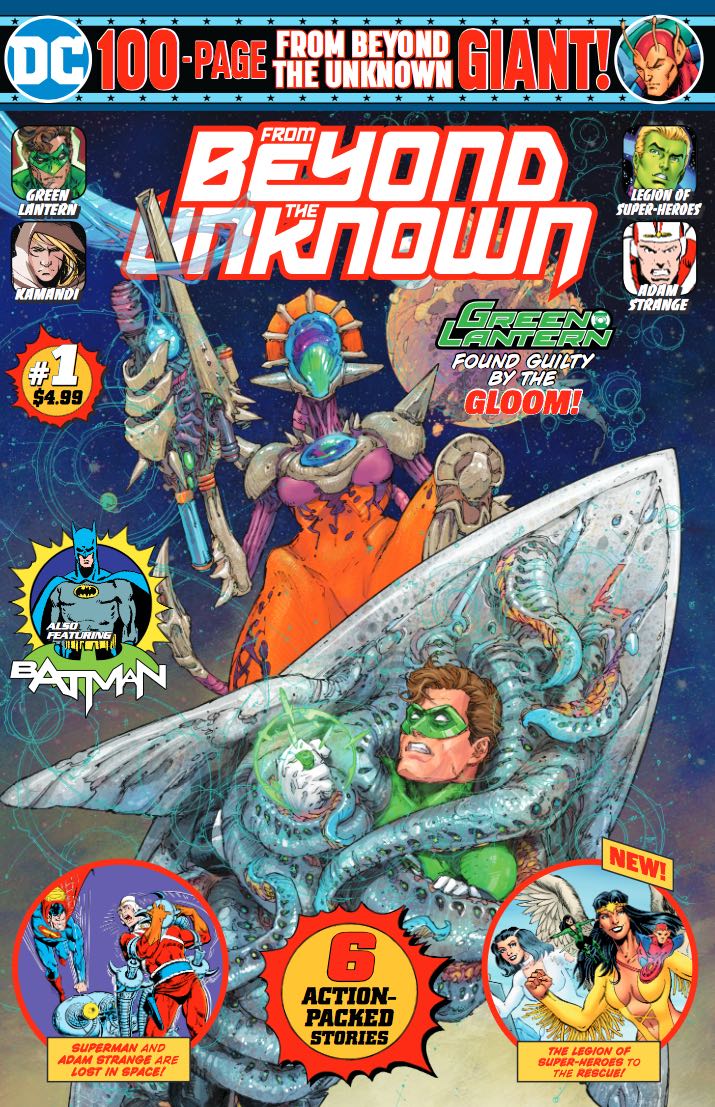
As mentioned here and elsewhere, there's a new Legion story out today in "From Beyond the Unknown Giant" #1, available at your finer Walmarts everywhere (that's what the indicia says on the inside back cover). The issue will also be sold at your local comic shop on March 25, with a new cover. In any case, the Walmart version has "Mass Market Edition" in the indicia, we'll see what the LCS version has next month.

The original From Beyond the Unknown, by the way, was a 1969-73 science fiction series from DC that reprinted stories from Silver Age titles like Mystery in Space and Strange Adventures, they're just reusing the title. And it's a 100-Page Giant, thus the name - it's the Giant version of "Beyond the Unknown", it has nothing to do with being beyond an Unknown Giant (I suppose if the Unknown Soldier gets Colossal Boy's powers, though....). The issue has a new Green Lantern story and a new Kamandi story, and reprints of Superman/Adam Strange from DC Comics Presents #3 and Batman/Metal Men from Brave and Bold #113, plus Alan Moore's F-Sharp Bell story from Tales of the Green Lantern Corps Annual #3.

Here's what the two covers will look like. The Direct Sales cover was revealed on Feb 20, 2020.

From Beyond the Unknown Giant #1
Walmart cover
Art by Jose Luis Garcia-Lopez
(reprinted from DC Comics Presents #2)
From Beyond the Unknown Giant #1
Direct Sales cover
Art by Kenneth Rocafort
(new art)


I didn't know why Dan Jurgens got to write a story about the Legion from the 1980s, so I asked him about it:
I wanted to try and figure out where it fits in continuity, because as I told Dan, I am a huge nerd at stuff like that. I thought I had narrowed it down to sometime between LSH v2 #295 (January, the Green Lantern story following the Great Darkness Saga) and LSH v2 #301 (July, new costumes for the Legionnaires), because:
  • Jacques first appears in LSH Annual #1 and joins at the end of the issue, which takes place in between issue #289 and #290. He doesn't get the white stripe in his hair until the end of issue #291 in the Great Darkness Saga, right after he saw Darkseid, and this story does not take place during the GDS.
  • Shrinking Violet, Chameleon Boy, and Colossal Boy all appear in their traditional Bronze Age costumes in this story (Violet in green, Cham in red and purple, and Colossal Boy with ornaments on his costume), and all had new costumes in issue 301 (Violet in purple, Cham in purple and yellow, and Colossal Boy without the eagle medallion). Each had their old costume at the end of #300 in the group shot.
However, while recording the podcast, Darren reminded me that Cham was either in custody or without his powers during that whole time frame. D'oh! I'll demote myself in rank from Captain Continuity to Corporal. So now where does it fit? Well, short answer, it doesn't fit between 295-300 after all:
  • Cham gets arrested early in issue 291, he arrives on Takron-Galtos in issue #292, and it's revealed in #296 that when he's pardoned, his powers have gone. He leaves with Brande to go to Durla in 300, and gets them back in 301.
So we're left with one of the following:
  1. Jacques is incorrectly shown with the white stripe in his hair, meaning this story takes place between LSH Annual 1 and LSH 290 (though he's more confident in this story than he was on his first mission in 290).
  2. Cham, Violet, and Colossal Boy are incorrectly shown with the wrong costumes in this story, which takes place after LSH 301.
The easiest answer is that there is one thing wrong rather than three, so let's go with Jacques's hair drawn incorrectly and say it's in between the Computo Annual and the start of the Great Darkness Saga. 

That said, there are some other anachronisms which I'll just chalk up to artistic license:
  • The Legion Cruiser in this new story is clearly the Cockrum version, which is distinguished by the teardrop shaped bubble on top of the saucer section, offset to the front (below, top). The Grell version has a round bubble that covers almost the entire saucer (below, left). Collectively, they were known as the Mark 10 Cruiser. But by 1983, they were using the Mark 494 version of the Cruiser anyway (below, right, from LSH 291).
  • Wildfire's costume is also the Cockrum version. Cockrum was the only one who drew Wildfire with the black visor wrapping under his chin, while Grell and everyone else who followed had the faceplate stopping around the lower lip area, allowing Wildfire to have a chin. His chest symbol in this story is also closer to the Cockrum version, with a winged star beneath the helmet on the center of his chest; by 1983, the winged star had grown and stretched down to his waist, merging with the red piece at his stomach that was separate from the star in his earlier appearances. Below, a Cockrum model sheet on the left, and Giffen/Mahlstedt from the cover of issue 298.
     Image result for wildfire legion
Not to get all fanfic-y about it, but to make up an in-universe explanation, they had to grab an old Cruiser because there were no Mark 494s available, and Wildfire's costume was malfunctioning so he grabbed an old one just like he did in LSH v3 #15 (below), after his regular one had been destroyed in the previous issue.

Phantom Girl is displayed with an interesting use of her power - she is shown phasing out of Dawnstar's body, having been inhabiting it. We've only seen that a handful of times. Val Beasley reminded me that Tinya hides inside Lightning Lad to survive a tornado in Superboy #201 (1974), I recalled one when Tinya's brother Gmya phased into Sun Boy's body (accidentally "eclipsing" him) while an assassin phased into another Legionnaire's body in Superboy #215 (1976), and Val also remembered at least once during the Reboot when Tinya hid out in Ultra Boy's body after everyone thought she was dead (LSH v4 #82 maybe?).

Given that this issue is marketed to the general Walmart shopper and not the hardcore DC fans, it's safe to say that this story was not written to the level of fandom as the 5YL version. We meet some never-before-seen aliens on a never-before-seen planet. It's relatively low stakes, nobody gets hurt, lessons are learned, and everyone lives happily ever after.

For what it is, it's an effective story. In 8 pages, we learn who the Legionnaires are, their names and powers, and wrap up an adventure. It's not trying to be the Bendis-written ongoing series. This could have worked as a fill-in backup story anywhere in the 80s, and I bet that was the intention.

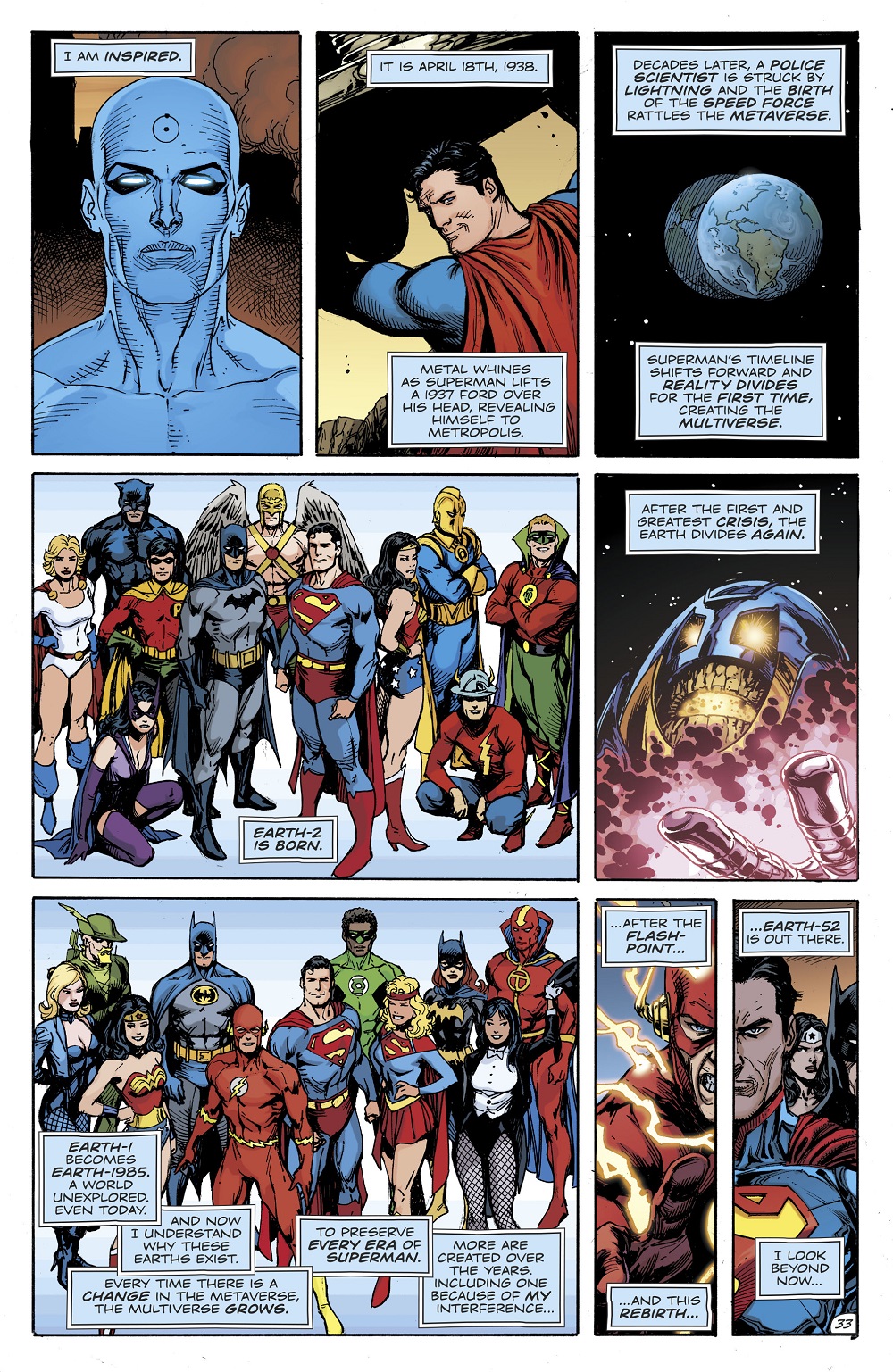
But given the finale of Doomsday Clock #12, the pre-Crisis Earth-1 is now known as Earth-1985, and the presence of a living Supergirl and Flash in panel 6 suggest that the cutoff point is prior to Crisis #1 where characters start dying. So this seems to be the first appearance of Earth-1985.

Tuesday, June 26, 2007

JLA 10/Flash 13: "I thought it was going to be someone else"

Previously: discussion here (in the comments) about Tle Villain Is tle Lero in lis Own Story, and the return of the Lightning Saga Legion later this year.

Well, even though everything's been said about JLA #10 and Flash #13, I'm gonna go ahead and do my shtick anyway. Yes, I'm a week late and about to be drowned out by the new week's stuff that comes out Wednesday afternoon, but what the hell. And even though Flash #13 doesn't actually contain any Legion stuff, it's very relevant to the big picture.

So it's the end of the Lightning Saga story, but certainly not the end of the story. There are too many loose ends, not the least of which are Starman and Karate Kid. Nice bit of misdirection there by Johns and Meltzer, making everyone think that the Legion went back in time to revive Barry Allen (Flash II). In fact it was a double-reverse: they dragged us through the whole issue and practically told us they were going to revive Barry, then hit us upside the head with Wally and family. And as the kicker, they really did revive Barry after all, but they never anticipated Wally to begin with, and he's in the future now.

I think DC did a disservice to the fans by practically telegraphing the endings to JLA and Flash with their spoilers last weekend at the conventions. They had kept the secret so well, everyone would have been shocked - shocked! - by the endings had they not known about Bart and Wally and the status of their books.

So we have questions, now that the story's over. In no particular order:

  1. Why did the Legion travel back in time to capture Barry within the lightning rod in the first place? That was what they wanted all along - as Brainy said, he was surprised that Wally came out of the lightning, but "we got who we wanted".

  2. For that matter, as Terence says in the comments, why did they need to send people rather than robots?

  3. Why did they lie to the JLA and JSA about what they were doing? Why was the mission so secret?

  4. They made some cryptic comments about Superman's future and how things are in the 31st century. What's going on there?

  5. What Earth or alternate dimension is this Legion from? They're not the "original" pre-Crisis Legion - Wildfire was never "related" to Red Tornado, Karate Kid is still alive, Ayla is apparently dead, Projectra never wore the Sensor Girl costume while Val was still alive, Dream Girl's powers are related to the Dreaming, the flight rings look different, etc. Starman mentions that Karate Kid "died too and came back". On the other hand - hey, Proty died after all, he didn't reanimate and take over Lightning Lad's body!

  6. What's the current version of Legion continuity with regards to Superman and the rest of the 20th/21st century super-heroes? Superman said that he never saw the Legion again after the first Crisis. I suppose that's true, if you don't count the time when the post-Crisis Superman (rebooted John Byrne version) met the post-Crisis Brainiac 5, Blok, Invisible Kid, and Sun Boy; and when he bounced around time by the Linear Men in "Time and Time Again", meeting the Adventure-era Legion, the 80's Legion, and helping to destroy the Moon in the Glorithverse v4 timeline. Plus, it's not like nobody ever heard of the Legion before - half the team was trapped in the 20th century for a while, and they took part in Final Night. Hell, even Batman met the post-Zero Hour Legion in Final Night, the Lightning Saga Legion, and next issue of Brave and Bold he'll meet the current v5 continuity Legion. (I wonder if he'll mention that?)


Some of these questions will be answered later this year when the Lightning Saga Legion returns later this year.

Part of the story was the return of Wally West, Flash III, and the apparent death of Bart Allen, Flash IV. Bart, of course, showed up prior to Zero Hour but was retconned to be from the post-Zero Hour Legion's future along with his cousin Jenni "XS" Ognats. Barry retired to the 30th century prior to the Crisis, fathered the Tornado Twins Don and Dawn Allen, then died in the Crisis. Then, when the post-Crisis Legion became the Glorithverse Legion and then the post-Zero Hour Legion, the extended Allen family was retconned to the post-ZH future (and thus when Barry retired to the 30th century, it was actually the post-Zero Hour pre-Crisis, not the pre-Crisis pre-Crisis or even the post-Crisis pre-Crisis). We had Bart as Impulse in the 20th century for a while, and Jenni in the 30th. Post-Infinite Crisis, I suppose the Allen family saga stayed the same but shifted to another new future, but Impulse (and his duplicate Inertia) never got their story told, and Jenni hasn't been seen since Earth-247.

I assume much of this (some?) will be covered by Mark Waid in his new Flash series later this year. He answers some questions over at Wizard:
WIZARD: Are you expecting joyous jumping in the streets with his return, or are you expecting people scratching their heads, or are you just going to stay off the Internet for a while?

WAID: Dude, believe me, I’m staying off the Internet. I’m actually having the DSL modem taken out of my house. I don’t know. It’s a complete crapshoot. We live in a world where people are celebratory about the fact that Tony Stark is a villain. I just can’t worry about that. All I can do is be true and faithful to how I perceive the characters. All I can really do is try to make something interesting out of Wally’s new status quo and try to give you stuff that you’ve never seen before in a Flash book.

WIZARD: One last thing about Bart's death: with the multiverse stuff in play are we seriously never going to see Bart again?

WAID: [Laughs] I plead the 5th on that. That's all I can say.

Bottom line, the whole Impulse chronology makes my head hurt almost as bad as keeping track of Legion chronology. Which may be a moot point, now that he appears dead. Now, the Lightning Saga Legion of some Earth's 31st century has Barry, and the JLA of Post-Infinite Crisis New Earth has Wally, while Bart is headed for parts unknown. In retrospect, "Lightning Saga" referred to the plan to resurrect Barry somehow in a manner similar to how they revived Lightning Lad, with Wally & co. riding the lightning.

Did everyone catch that the twins costumes are duplicates of what Don and Dawn originally wore in 1968?

(pictures via)

A sampling of reader reactions that ran the gamut of "best book of the week" to "worst book". I'll cover them in the order I found them:
  • Blurred Productions:
    So I read the JLA #10/Flash #13 one-two punch that was released today. And these were bad, bad comics.

    Let’s start with Justice League. I have been wondering what the fucking point of this whole JLA/JSA/Legion-that-isn’t-supposed-to-exist-anymore crossover was. I guess now we know, it was to bring Wally West back (and trap Barry Allen’s soul?). What Wally West and the old Legion of Superheroes have to do with each other I will never know...

    Which, of course, brings us to Flash #13. Honestly, was there any point to all of this? The last 12 issues of this series have been a complete waste of what had once been an interesting character...

  • Graeme the Savage Critic:
    So, am I the only one who feels that DC has truly fucked up The Flash? Not the character necessarily, but I'm really referring to what was revealed this past weekend... because the shocking end that everyone's worked so hard to keep a secret was revealed last weekend at Heroes Con and Wizard World and then online (And again, what the fuck? They couldn't have either kept it secret for another week, or else managed to make the book ship on time?), there's absolutely no tension in the book.

    Maybe even more confusing, in terms of DC's knack of spoiling their own comics online before they're released, is what isn't in this comic - An announcement that fans should probably check out JUSTICE LEAGUE OF AMERICA #10 for the next part of the story. The final part of "The Lightning Saga," you see, ends with the triumphant return of the Flash.

    Justice League of America #10 is an Awful ending to the JLA/JSA crossover. The return of Wally comes out of nowhere - well, kind of nowhere, in that lots of people have been expecting this particular misdirection due to the name of the storyline - and isn't given any attempt at explanation in the story at all. The fact that we're seeing an entirely different Legion of Super-Heroes from the ones who have their own series isn't really given any attempt at explanation (There's one line of dialogue which kind of suggests that they're from Earth-2? Maybe?). Why this alternaretroLegion came back in time to resurrect a character that wasn't definitively dead in the first place is given no attempt at explanation, either; instead, we're given scenes that hint that the Legion had an ulterior motive, but, of course, that's not explained either. It's hard for me to say how truly sloppy this final chapter is, even compared with the earlier parts of this story. It's truly fan-fiction that somehow got published by a real company.

  • Tom Bondurant, the Grumpy Old Fan at Blog@Newsarama:
    Instead, Bart dies almost as an afterthought, killed by the Rogues’ Gallery. “Killed by Dan Didio is more like it,” I can hear you saying. “First the JLI, now Young Justice.”

    Those patterns are certainly present … and if the Great DC War On Fun is behind these deaths, here’s my explanation: fun is a luxury. Fun is for people who don’t have to worry about the real world. Fun is for characters whose existences don’t have to be justified. Fun can also be pretty hard to pull off, especially when a character’s corporate owner gets concerned about “realism.”

    That naturally brings me to Justice League #10, an issue which made very little sense except as part of a larger shared-universe storyline. ... As the conclusion to “The Lightning Saga,” JLA #10 was bewildering. As the reintroduction of Wally West, though, I found it surprisingly affecting. ... I’m glad Wally’s back, because his circumstances didn’t need fixing in the first place. However, I’m sorry Bart had to be wrecked in the process.

  • The Comic Book Revolution (Flash review, JLA review)
    Now that I have praised Guggenheim for delivering the best issue he could with what DC gave him, I’m now going to address the huge mistake that I feel Flash #13 was. Was it really necessary to kill Bart Allen?

    I was really hoping that Bart would be sent back to the future to work with the Legion of Super Heroes. Or maybe that since the Multiverse is back and better than ever, that it would provide DC the perfect literary vehicle to place Bart in another universe where he could be the Flash. Unfortunately, it is the long dirt nap for Bart. Oh well, honestly, I’d much rather have Barry or Wally than Bart as the Flash. But, that doesn’t mean that I wanted to see Bart killed off.

    Justice League of America #10 was a great ending to a story arc that I have completely enjoyed. Meltzer gives us a well paced issue. The issue gradually builds in intensity and gains speed with each page as we tick down to the moment of impact.

    Yeah, DC teased us with the return of Barry Allen. Especially with the visions that Batman and Hal Jordan had just prior to Wally making his grand return. And Batman was visibly stunned that it was Wally who the Legion was bringing back and not Barry. But, maybe Batman was right after all. Because, after Wally’s dramatic return, Meltzer then drops another bomb on the reader. Wally West was not the person that the Legion was trying to bring back to life.

    There are some many questions with regard to the Pre-Crisis Legion. What is the great threat that they are facing? What happened to the Legion that caused them to sever their ties with Superman? I am fascinated with the return of the Pre-Crisis Legion and I cannot wait to see what DC has in store for the Pre-Crisis Legion. Personally, I’d be thrilled if we found out that the current version of the Legion of Super Heroes is actually from an alternate universe and that the Pre-Crisis Legion is the Legion from New Earth’s future.

  • I Was a Bronze Age Boy:
    Whacking superheroes is all the rage these days. It’s like the Sopranos have infiltrated the upper echelon of Marvel and DC editorial.

    So, Bart croaks in this week’s issue #13. It would have been a shock, thanks to DC’s loose-lips-sink-ships tactics if...IF THEY HADN’T SPILLED THE BEANS AT A CONVENTION FIVE DAYS BEFORE THE FRIGGIN’ BOOK CAME OUT!

    And over in the sleep-inducing Justice League of America #10 (where Power Girl’s, uh, power must be the ability to make those puppies defy gravity), Wally West and his family are brought back to Earth by 31st Century Legion of Super-Heroes technology. Don’t Ask. Two books. Two Flashes. Two comics that won’t make this week's Best Of list.

  • Jimmy Olsen's Blues, channeling the late Bart:
    Just in time to not save me, Wally's back. Maybe if the Legion of Super-Heroes hadn't spent so much time keeping their plans secret for no good reason, they could've brought him back a little quicker and I'd at least still be alive. Mark Waid would never have gone for this kind of shabby treatment of any Flash. If he was writing the book, I'd be back as the Fastest Man Alive any month now...

    DC News of the Week: Mark Waid Returns to Flash; Wally West on Cover of First Story -

    ...God damn it.

  • All About Comics:
    Gosh, my heart is overcome with the tragedy of Bart’s death — or would be, I guess, if this had any sense of poignancy or drama, and didn’t just seem like a soulless corporate reaction to the current lack of interest or sales to this version of the character.

    This offers the conclusion to the JLA/JSA/LSH crossover, and it turns out the Legion was trying to bring back… Wally West. Um, OK. This makes no actual sense, since West has never had any connection to the Legion (where bringing back Barry Allen, say, would at least have had the tangential connection offered by the Tornado Twins...), and the feel is that West is back because… well, because DC wanted him back; no other reason. This whole crossover just sputters to a close, and it’s convinced me to drop this title
    .
  • Kalinara and the Occasional Superheroine and their respective commenters weigh in on Bart vs Wally and how it all went down.

  • Comics Should Be Good at CBR:
    Okay, this is the conclusion of the big JLA/JSA crossover, “The Lightning Saga.” Oooohhhh, that means there’s some terrible threat to the world that necessitates the two teams getting together, right? That means this is going to be a big smash-’em-up, because when two superhero groups get together, they have to fight something that challenges them really seriously.

    Let’s look at the obvious problem: there’s no villain. This is a crossover between the premier team of the DCU and one that for the past decade has been shoved down our throats even though they’re made up of geezers, plus the added bonus of having a bunch of heroes from the future, and they don’t fight anyone! I can’t speak for the rest of the crossover, so maybe they cleaned up the villain last issue and it turned out the villain was just a ruse, but this the climactic issue, and the closest we get to a fight is the tentacles at the beginning. What the crap? Added to this is the fact that the actual point of the issue is handled really poorly. The Legion comes back in time to bring someone back from the dead. The League thinks it’s Lightning Lad, but the clues in this issue point to Barry Allen. But really, it’s Wally. Fine. But why is the League fighting them? Why, even after they realize that they’re bringing someone back from the dead, do they try to stop them? Why is the Legion trying to deceive them in the first place? Why would Superman be so offended? “You can’t bring anyone back from the dead - dead means dead!” “Yeah, Superman, tell that to Doomsday.” I mean, why on earth is the entire issue devoted to two groups of superheroes trying to stop a third from bringing someone back from the dead?

    I really, really apologize for going on so much about this horrible comic book. It has to be said, though: this sucks. It sucks worse than The Flash #13, because although that ended with a stupid death rather than a stupid resurrection, at least there was a villain that Bart defeated (sort of) before he got kicked to death. This has no bad guy, no big fight, no character development, no humor, no sense of grandeur, and no point beyond bringing a character back from the dead. It’s astonishing that this comic is DC’s best-selling comic. The only reason I can think of that is that people simply are desperate to see their favorite characters in a book together. That’s a terrible reason to buy a comic book.

  • FanBoyWonder:
    But we talk about the death of “Bart Allen” in quotes because this character who filled these pages for 13 issues was NOT the Bart Allen we knew and loved. This Wally West Clone (we don’t use that word by chance) appeared in issue One and there was an expectation, a demand almost, that readers connect to this stranger with a familiar name (well two names, “Bart Allen” and “Flash”).

    “Bart Allen” was to the DC Universe what Ben Reilly was to the Marvel Universe. When we watched “Bart” die at the end of #13, we immediately recall feeling the same way when the clone of Peter Parker, one-time Scarlet Spider and replacement Spider-Man bit the dust (literally) quite abruptly when Marvel realized what the Spider-Clone story line was doing to the entire Spider-Man franchise.

    The Lightning Saga took a LONG time to get where it was going and while there was a rewarding payout at the end in the form of the return of Wally West/Flash and his wife and (now apparently teenaged) kids from the Speed Force or wherever, this JLA/JSA/Legion cross-over never really captured our imagination or frankly our interest for that matter.

    We did like the feeling of build up and the bit of a fake out where it seemed that it was Barry Allen that the Legion was going to bring back with their Lightning Rods. And apparently they thought so too—so Wally’s return is a happy accident.

  • Here are Don McPherson's annotations of the Lightning Saga.

  • Suspension of Disbelief shows us how Power Girl got a breast reduction between the time the original cover was solicited a couple months ago and this issue.

Final notes: I found this interesting post by Yonatan Bryant. He got into comics in the early 90s, practically a generation after me and the other old fogies who remember the Legion (and the JLA, etc.) of the 70s and 80s. We, collectively, are the main fans of comics today, and we are now the creators. But we're not the only ones.
See, while the Legion above might be a bunch of peoples Legion, they are not mine. My Legion is the post zero hour Legion. It is a strong and powerful Legion that does not need a Kryptonian to survive. It is a Legion that will get you to do something for them, as Cosmic Boy said in The Legion 3, not because of their powers, or their numbers, but because they are the Legion, and you follow what the Legion says. That is also my main complaint with the newest version of the Legion: They do not command respect. That and the fact that Gates is not a member.

But at the end of everything, Kyle is my Green Lantern, Wally is my Flash, Conner is my Green Arrow, my JLA kicks ass, my Legion of Superheroes are from the post boot era. Someday they will return.

We, the fans and creators, would do well to keep that in mind.